Pete, an apology for that.
Below come the answers to your questions:
#define CONFIG_BLYNK_TEMPLATE_ID “REDACTED”
#define CONFIG_BLYNK_TEMPLATE_NAME “REDACTED”
1.This is the entire file: mqtt_gsm_main.c
/*
* SPDX-FileCopyrightText: 2024 Andrii Yarmolenko for Blynk Technologies Inc.
* SPDX-License-Identifier: Apache-2.0
*/
#include <stdio.h>
#include <stdint.h>
#include <stdlib.h>
#include <inttypes.h>
#include <string.h>
#include "freertos/FreeRTOS.h"
#include "freertos/task.h"
#include "freertos/event_groups.h"
#include "esp_system.h"
#include "esp_event.h"
#include "esp_log.h"
#include "esp_netif.h"
#include "nvs.h"
#include "nvs_flash.h"
#include "esp_console.h"
#include "argtable3/argtable3.h"
#include "esp_ota_ops.h"
#include "esp_http_client.h"
#include "esp_https_ota.h"
#include "driver/uart.h"
#include "driver/gpio.h"
#include "netif/ppp/pppos.h"
#include "netif/ppp/ppp.h"
#include "lwip/err.h"
#include "netif/ppp/pppapi.h"
#include <esp_wifi.h>
#include <cJSON.h>
#include "mqtt_client.h"
#if !defined(CONFIG_BLYNK_FIRMWARE_TYPE) && defined(CONFIG_BLYNK_TEMPLATE_ID)
#define CONFIG_BLYNK_FIRMWARE_TYPE CONFIG_BLYNK_TEMPLATE_ID
#endif
#if !defined(CONFIG_BLYNK_FIRMWARE_VERSION)
#define CONFIG_BLYNK_FIRMWARE_VERSION "0.0.0"
#endif
#if !defined(CONFIG_BLYNK_TEMPLATE_ID) || !defined(CONFIG_BLYNK_TEMPLATE_NAME)
#error "Please specify your BLYNK_TEMPLATE_ID and BLYNK_TEMPLATE_NAME"
#endif
#define BLYNK_PARAM_KV(k, v) k "\0" v "\0"
#if CONFIG_BLYNK_MQTTS_MODE
#include "root_certificates.h"
static const char *MQTTTAG = "[MQTTS]";
#else
static const char *MQTTTAG = "[MQTT]";
#endif
static TickType_t mqtt_offline_timestamp = 0;
static TaskHandle_t modem_task = NULL;
static ppp_pcb *ppp = NULL;
static struct netif ppp_netif;
static void gsm_init(void);
static int get_nvs_blynk_auth_token(char *token, size_t *len)
{
nvs_handle_t my_handle;
if (nvs_open("storage", NVS_READONLY, &my_handle) != ESP_OK)
{
ESP_LOGE("NVS", "can't open storage");
return -1;
}
const int rc = nvs_get_str(my_handle, "blynk_token", token, len);
nvs_close(my_handle);
return rc;
}
static int set_nvs_blynk_auth_token(const char *token)
{
nvs_handle_t my_handle;
if (nvs_open("storage", NVS_READWRITE, &my_handle) != ESP_OK)
{
ESP_LOGE("NVS", "can't open storage");
return -1;
}
const int rc = (ESP_OK != nvs_set_str(my_handle, "blynk_token", token) || ESP_OK != nvs_commit(my_handle));
nvs_close(my_handle);
return rc;
}
static int starts_with(const char *str, const char *prefix)
{
size_t len_prefix = strlen(prefix);
size_t len_str = strlen(str);
if (len_str < len_prefix) {
return 0;
}
return strncmp(str, prefix, len_prefix) == 0;
}
static u32_t p_output_callback(ppp_pcb *pcb, u8_t *data, u32_t len, void *ctx)
{
const uint32_t ret = uart_write_bytes(CONFIG_GSM_UART_NUM, (const char*)data, len);
//uart_wait_tx_done(CONFIG_GSM_UART_NUM, 10 / portTICK_PERIOD_MS);
return ret;
}
static int send_cmd(const uart_port_t uart_num, const char *cmd, const char *rsp1, const char *rsp2, const int timeout_ms)
{
uart_flush(CONFIG_GSM_UART_NUM);
uart_write_bytes(CONFIG_GSM_UART_NUM, cmd, strlen(cmd));
uart_wait_tx_done(CONFIG_GSM_UART_NUM, 10 / portTICK_PERIOD_MS);
#if CONFIG_GSM_AT_CMD_DEBUG
ESP_LOGI("[GSM]", "snd[%s]", cmd);
#endif
uint8_t d[256];
int len = 0;
for (int i = 0; i < timeout_ms; i += 20)
{
const int len_tmp = uart_read_bytes(CONFIG_GSM_UART_NUM, d + len, sizeof(d) - len - 1, 20 / portTICK_PERIOD_MS);
if (len_tmp)
{
len += len_tmp;
d[len] = '\0';
#if CONFIG_GSM_AT_CMD_DEBUG
ESP_LOGI("[GSM]", "rcv[%s]", d);
#endif
if (rsp1 && strstr((const char *)d, rsp1))
{
return 1;
}
if (rsp2 && strstr((const char *)d, rsp2))
{
return 2;
}
}
}
return -1;
}
static void p_status_cb(ppp_pcb *pcb, int err_code, void *ctx)
{
LWIP_UNUSED_ARG(ctx);
struct netif *pppif = ppp_netif(pcb);
switch (err_code) {
case PPPERR_NONE:
ESP_LOGI("[GSM]","status_cb: Connected");
#if PPP_IPV4_SUPPORT
ESP_LOGI("[GSM]"," ipaddr = %s", ipaddr_ntoa(&pppif->ip_addr));
ESP_LOGI("[GSM]"," gateway = %s", ipaddr_ntoa(&pppif->gw));
ESP_LOGI("[GSM]"," netmask = %s", ipaddr_ntoa(&pppif->netmask));
#endif
#if PPP_IPV6_SUPPORT
ESP_LOGI("[GSM]"," ip6addr = %s", ip6addr_ntoa(netif_ip6_addr(pppif, 0)));
#endif
break;
case PPPERR_PARAM:
ESP_LOGE("[GSM]","status_cb: Invalid parameter");
break;
case PPPERR_OPEN:
ESP_LOGE("[GSM]","status_cb: Unable to open PPP session");
break;
case PPPERR_DEVICE:
ESP_LOGE("[GSM]","status_cb: Invalid I/O device for PPP");
break;
case PPPERR_ALLOC:
ESP_LOGE("[GSM]","status_cb: Unable to allocate resources");
break;
case PPPERR_USER:
/* ppp_free(); -- can be called here */
ESP_LOGW("[GSM]","status_cb: User interrupt (disconnected)");
break;
case PPPERR_CONNECT:
ESP_LOGE("[GSM]","status_cb: Connection lost");
break;
case PPPERR_AUTHFAIL:
ESP_LOGE("[GSM]","status_cb: Failed authentication challenge");
break;
case PPPERR_PROTOCOL:
ESP_LOGE("[GSM]","status_cb: Failed to meet protocol");
break;
case PPPERR_PEERDEAD:
ESP_LOGE("[GSM]","status_cb: Connection timeout");
break;
case PPPERR_IDLETIMEOUT:
ESP_LOGE("[GSM]","status_cb: Idle Timeout");
break;
case PPPERR_CONNECTTIME:
ESP_LOGE("[GSM]","status_cb: Max connect time reached");
break;
case PPPERR_LOOPBACK:
ESP_LOGE("[GSM]","status_cb: Loopback detected");
break;
default:
ESP_LOGE("[GSM]","status_cb: Unknown error code %d", err_code);
break;
}
if (err_code != PPPERR_USER && err_code != PPPERR_NONE && ppp)
{
//gsm_init();
}
}
static void gsm_task(void *pvParameters)
{
if (uart_is_driver_installed(CONFIG_GSM_UART_NUM))
{
uart_driver_delete(CONFIG_GSM_UART_NUM);
}
gpio_set_direction(CONFIG_GSM_UART_GPIO_TX, GPIO_MODE_OUTPUT);
gpio_set_direction(CONFIG_GSM_UART_GPIO_RX, GPIO_MODE_INPUT);
gpio_set_pull_mode(CONFIG_GSM_UART_GPIO_RX, GPIO_PULLUP_ONLY);
const uart_config_t uart_config =
{
.baud_rate = CONFIG_GSM_UART_BAUDRATE,
.data_bits = UART_DATA_8_BITS,
.parity = UART_PARITY_DISABLE,
.stop_bits = UART_STOP_BITS_1,
.flow_ctrl = UART_HW_FLOWCTRL_DISABLE
};
uart_param_config(CONFIG_GSM_UART_NUM, &uart_config);
uart_set_pin(CONFIG_GSM_UART_NUM, CONFIG_GSM_UART_GPIO_TX, CONFIG_GSM_UART_GPIO_RX, UART_PIN_NO_CHANGE, UART_PIN_NO_CHANGE);
uart_driver_install(CONFIG_GSM_UART_NUM, CONFIG_GSM_BUF_SIZE, CONFIG_GSM_BUF_SIZE, 0, NULL, 0);
while (1)
{
ESP_LOGI("[GSM]","modem init start");
gpio_set_level(CONFIG_GSM_PWR_ON, 1);
vTaskDelay(10 / portTICK_PERIOD_MS);
#if (CONFIG_GSM_PWR_KEY > 0)
gpio_set_level(CONFIG_GSM_PWR_KEY, 0);
vTaskDelay(1500 / portTICK_PERIOD_MS);
gpio_set_level(CONFIG_GSM_PWR_KEY, 1);
vTaskDelay(1500 / portTICK_PERIOD_MS);
#endif
int i;
for (i = 0; i < 60; i++)
{
const int rc = send_cmd(CONFIG_GSM_UART_NUM, "AT\r\n", "OK", "0", 1000);
if (1 == rc || 2 == rc)
{
break;
}
}
if (i == 60)
{
ESP_LOGE("[GSM]","modem not answer");
continue;
}
else
{
ESP_LOGI("[GSM]","modem found");
}
#if CONFIG_GSM_AT_CMD_DEBUG
send_cmd(CONFIG_GSM_UART_NUM, "AT+CNUM\r\n", "OK", "0", 500);
#endif
for (i = 0; i < 60; i++)
{
const int r = send_cmd(CONFIG_GSM_UART_NUM, "AT+CREG?\r\n", "+CREG: 0,1", "+CREG: 0,5", 1000);
if (r == 1 || r == 2)
{
break;
}
}
if (i == 60)
{
ESP_LOGE("[GSM]","modem not registering");
continue;
}
else
{
ESP_LOGI("[GSM]","modem registration OK");
}
vTaskDelay(2500 / portTICK_PERIOD_MS);
send_cmd(CONFIG_GSM_UART_NUM, "AT+CGDCONT=1,\"IP\",\"internet\"\r\n", "OK", NULL, 500);
vTaskDelay(4000 / portTICK_PERIOD_MS);
if (1 == send_cmd(CONFIG_GSM_UART_NUM, "ATD*99#\r\n", "CONNECT", "ERROR", 15000))
{
ESP_LOGI("[GSM]","modem connected");
memset(&ppp_netif, 0, sizeof(ppp_netif));
ppp = pppapi_pppos_create(&ppp_netif, p_output_callback, p_status_cb, NULL);
pppapi_set_default(ppp);
pppapi_connect(ppp, 0);
uint8_t d1[CONFIG_GSM_BUF_SIZE];
while (1)
{
const int len = uart_read_bytes(CONFIG_GSM_UART_NUM, d1, CONFIG_GSM_BUF_SIZE, 10 / portTICK_PERIOD_MS);
if (len)
{
pppos_input_tcpip(ppp, (u8_t*)d1, len);
}
}
}
else
{
ESP_LOGE("[GSM]","modem can't connect");
}
}
}
static void gsm_init(void)
{
if (ppp)
{
ESP_LOGI("[GSM]","disable PPP interface");
pppapi_close(ppp, 0);
pppapi_free(ppp);
ppp = NULL;
}
if (modem_task)
{
ESP_LOGI("[GSM]","restart modem task");
vTaskDelete(modem_task);
modem_task = NULL;
}
xTaskCreate(gsm_task,
"gsm_task",
4096 * 2,
NULL,
4,
&modem_task);
}
static void log_error_if_nonzero(const char *message, int error_code)
{
if (error_code != 0)
{
ESP_LOGE(MQTTTAG, "Last error %s: 0x%x", message, error_code);
}
}
static void mqtt_event_handler(void *handler_args, esp_event_base_t base, int32_t event_id, void *event_data)
{
ESP_LOGD(MQTTTAG, "Event dispatched from event loop base=%s, event_id=%" PRIi32 "", base, event_id);
esp_mqtt_event_handle_t event = event_data;
esp_mqtt_client_handle_t client = event->client;
char s[64];
switch ((esp_mqtt_event_id_t)event_id) {
case MQTT_EVENT_BEFORE_CONNECT:
ESP_LOGI(MQTTTAG, "MQTT_EVENT_BEFORE_CONNECT");
break;
case MQTT_EVENT_CONNECTED:
ESP_LOGI(MQTTTAG, "MQTT_EVENT_CONNECTED");
mqtt_offline_timestamp = 0;
esp_mqtt_client_subscribe(client, "downlink/#", 0);
cJSON *root;
root = cJSON_CreateObject();
cJSON_AddItemToObject(root, "tmpl", cJSON_CreateString(CONFIG_BLYNK_TEMPLATE_ID));
cJSON_AddItemToObject(root, "ver", cJSON_CreateString(CONFIG_BLYNK_FIRMWARE_VERSION));
cJSON_AddItemToObject(root, "build", cJSON_CreateString(__DATE__ " " __TIME__));
cJSON_AddItemToObject(root, "type", cJSON_CreateString(CONFIG_BLYNK_FIRMWARE_TYPE));
cJSON_AddNumberToObject(root, "rxbuff", 512);
char *rendered=cJSON_Print(root);
esp_mqtt_client_publish(client, "info/mcu", rendered, 0, 1, 0);
free(rendered);
cJSON_Delete(root);
snprintf(s, sizeof(s), "%d", rand() % 100);
esp_mqtt_client_publish(client, "ds/Random", s, 0, 1, 0);
break;
case MQTT_EVENT_SUBSCRIBED:
ESP_LOGI(MQTTTAG, "MQTT_EVENT_SUBSCRIBED, msg_id=%d", event->msg_id);
break;
case MQTT_EVENT_DISCONNECTED:
ESP_LOGI(MQTTTAG, "MQTT_EVENT_DISCONNECTED");
if (!mqtt_offline_timestamp)
{
ESP_LOGI(MQTTTAG, "just got offline");
mqtt_offline_timestamp = xTaskGetTickCount();
}
else
{
const TickType_t now = xTaskGetTickCount();
const int offline_seconds = (now - mqtt_offline_timestamp) * portTICK_PERIOD_MS / 1000;
const int gsm_reinit = offline_seconds >= 180;
ESP_LOGI(MQTTTAG, "offline already %d seconds %s", offline_seconds, gsm_reinit ? "rebooting gsm" : "");
if (gsm_reinit)
{
mqtt_offline_timestamp = now;
gsm_init();
}
}
break;
case MQTT_EVENT_UNSUBSCRIBED:
ESP_LOGI(MQTTTAG, "MQTT_EVENT_UNSUBSCRIBED, msg_id=%d", event->msg_id);
break;
case MQTT_EVENT_PUBLISHED:
ESP_LOGI(MQTTTAG, "MQTT_EVENT_PUBLISHED, msg_id=%d", event->msg_id);
break;
case MQTT_EVENT_DATA:
ESP_LOGI(MQTTTAG, "MQTT_EVENT_DATA");
const char ota_topic_name[] = "downlink/ota/json";
const size_t ota_topic_len = strlen(ota_topic_name);
const char redir_topic_name[] = "downlink/redirect";
const size_t redir_topic_len = strlen(redir_topic_name);
if ((event->topic_len >= ota_topic_len)
&& !memcmp(event->topic, ota_topic_name, ota_topic_len))
{
ESP_LOGI("[OTA]", "start");
cJSON *root = cJSON_ParseWithLength(event->data, event->data_len);
ESP_LOGI("[OTA]", "url[%s]", cJSON_GetObjectItem(root, "url")->valuestring);
ESP_LOGI("[OTA]", "size[%d]", cJSON_GetObjectItem(root, "size")->valueint);
ESP_LOGI("[OTA]", "type[%s]", cJSON_GetObjectItem(root, "type")->valuestring);
ESP_LOGI("[OTA]", "ver[%s]", cJSON_GetObjectItem(root, "ver")->valuestring);
ESP_LOGI("[OTA]", "build[%s]", cJSON_GetObjectItem(root, "build")->valuestring);
esp_http_client_config_t config = {
.url = cJSON_GetObjectItem(root, "url")->valuestring,
.cert_pem = (char *)CA_CERT,
.keep_alive_enable = true,
};
esp_https_ota_config_t ota_config = {
.http_config = &config,
};
ESP_LOGI("[OTA]", "Attempting to download update from %s", config.url);
esp_err_t ret = esp_https_ota(&ota_config);
if (ret == ESP_OK) {
ESP_LOGI("[OTA]", "OTA Succeed, Rebooting...");
esp_restart();
} else {
ESP_LOGE("[OTA]", "Firmware upgrade failed [%d]", ret);
}
cJSON_Delete(root);
}
else if ((event->topic_len >= redir_topic_len)
&& !memcmp(event->topic, redir_topic_name, redir_topic_len))
{
ESP_LOGI(MQTTTAG, "got redirect to [%.*s]", event->data_len, event->data);
char *uri = malloc(event->data_len + 128);
if (uri)
{
memcpy(uri, event->data, event->data_len);
uri[event->data_len] = '\0';
char prot[32];
char addr[128];
int port;
while (strchr(uri, '/'))
{
*(char*)strchr(uri, '/') = ' ';
}
while (strchr(uri, ':'))
{
*(char*)strchr(uri, ':') = ' ';
}
if (3 == sscanf(uri, "%s %s %d", prot, addr, &port))
{
uri[0] = '\0';
#if CONFIG_BLYNK_MQTTS_MODE
if (!strcmp(prot, "tls") || !strcmp(prot, "mqtts"))
{
strcat(uri, "mqtts://");
}
#endif
if (!strcmp(prot, "tcp") || !strcmp(prot, "mqtt"))
{
strcat(uri, "mqtt://");
}
if (!strcmp(prot, "ws") || !strcmp(prot, "wss"))
{
sprintf(uri, "%s://", prot);
}
if (!strstr(uri, "://"))
{
ESP_LOGE(MQTTTAG, "wrong protocol [%s]", prot);
}
else
{
char t[34];
size_t l = sizeof(t);
if (ESP_OK != get_nvs_blynk_auth_token(t, &l))
{
ESP_LOGE(MQTTTAG, "Can't read auth token. please configure it and reboot");
}
sprintf(uri + strlen(uri), "device:%s@%s:%u", t, addr, port);
const esp_err_t r0 = esp_mqtt_client_disconnect(client);
const esp_err_t r1 = esp_mqtt_client_set_uri(client, uri);
if (ESP_OK != r1 || ESP_OK != r0)
{
ESP_LOGE(MQTTTAG, "can't redirect to [%s] [%s] [%s]", uri, esp_err_to_name(r0), esp_err_to_name(r1));
}
}
}
else
{
ESP_LOGE(MQTTTAG, "malformed redirect address [%.*s]", event->data_len, event->data);
}
free(uri);
}
else
{
ESP_LOGE(MQTTTAG, "can't allocate uri");
}
}
ESP_LOGI(MQTTTAG, "TOPIC=%.*s", event->topic_len, event->topic);
ESP_LOGI(MQTTTAG, "DATA=%.*s", event->data_len, event->data);
break;
case MQTT_EVENT_ERROR:
ESP_LOGI(MQTTTAG, "MQTT_EVENT_ERROR");
if (event->error_handle->error_type == MQTT_ERROR_TYPE_TCP_TRANSPORT) {
log_error_if_nonzero("reported from esp-tls", event->error_handle->esp_tls_last_esp_err);
log_error_if_nonzero("reported from tls stack", event->error_handle->esp_tls_stack_err);
log_error_if_nonzero("captured as transport's socket errno", event->error_handle->esp_transport_sock_errno);
ESP_LOGI(MQTTTAG, "Last errno string (%s)", strerror(event->error_handle->esp_transport_sock_errno));
}
break;
default:
ESP_LOGI(MQTTTAG, "Other event id:%d", event->event_id);
break;
}
}
static esp_mqtt_client_handle_t* mqtt_app_start(void)
{
esp_mqtt_client_config_t mqtt_cfg = {};
char uri[256];
if (!starts_with(CONFIG_BLYNK_TEMPLATE_ID, "TMPL") ||
!strlen(CONFIG_BLYNK_TEMPLATE_NAME)
) {
ESP_LOGE(MQTTTAG, "Invalid configuration of TEMPLATE_ID / TEMPLATE_NAME");
return NULL;
}
char t[34];
size_t l = sizeof(t);
if (ESP_OK != get_nvs_blynk_auth_token(t, &l))
{
ESP_LOGE(MQTTTAG, "Can't read auth token. please configure it and reboot");
return NULL;
}
#if CONFIG_BLYNK_MQTTS_MODE
snprintf(uri, sizeof(uri), "mqtts://device:%s@%s:8883", t, CONFIG_BLYNK_SERVER);
mqtt_cfg.broker.verification.certificate = (const char *)CA_CERT;
#else
snprintf(uri, sizeof(uri), "mqtt://device:%s@%s:1883", t, CONFIG_BLYNK_SERVER);
#endif
uri[sizeof(uri) - 1] = '\0';
mqtt_cfg.broker.address.uri = uri;
// mqtt_cfg.network.disable_auto_reconnect = true;
esp_mqtt_client_handle_t *client = malloc(sizeof(esp_mqtt_client_handle_t));
if (client)
{
*client = esp_mqtt_client_init(&mqtt_cfg);
if (ESP_OK != esp_mqtt_client_register_event(*client, ESP_EVENT_ANY_ID, mqtt_event_handler, NULL) ||
ESP_OK != esp_mqtt_client_start(*client))
{
free(client);
client = NULL;
}
}
return client;
}
static void brd_init(void)
{
const gpio_config_t io_conf =
{
.intr_type = GPIO_INTR_DISABLE,
.mode = GPIO_MODE_OUTPUT,
#if (CONFIG_GSM_PWR_KEY > 0)
.pin_bit_mask = ((1ULL<<CONFIG_GSM_PWR_KEY) | (1ULL<<CONFIG_GSM_PWR_ON)),
#else
.pin_bit_mask = ((1ULL<<CONFIG_GSM_PWR_ON)),
#endif
.pull_down_en = 0,
.pull_up_en = 0,
};
gpio_config(&io_conf);
}
int nvs_init(void)
{
esp_err_t err = nvs_flash_init();
if (err == ESP_ERR_NVS_NO_FREE_PAGES || err == ESP_ERR_NVS_NEW_VERSION_FOUND) {
ESP_ERROR_CHECK(nvs_flash_erase());
err = nvs_flash_init();
}
return ESP_OK != err;
}
static int blynk_cmd_cb(int argc, char **argv)
{
if (argc == 2)
{
printf("%s\n", set_nvs_blynk_auth_token(argv[1]) ? "error" : "ok");
}
else
{
printf("wrong usage\n");
}
return 0;
}
typedef struct {
struct arg_str *token;
struct arg_end *end;
} auth_cmd_t;
static esp_console_cmd_t auth_cmd = {};
static auth_cmd_t auth_cmd_args = {};
static void register_auth_key_cmd(void)
{
esp_console_repl_t *repl = NULL;
esp_console_repl_config_t repl_config = ESP_CONSOLE_REPL_CONFIG_DEFAULT();
repl_config.prompt = "BLYNK>";
repl_config.max_cmdline_length = 256;
auth_cmd_args.token = arg_str0(NULL, NULL, "REDACTED", "blynk auth token");
auth_cmd_args.end = arg_end(1);
auth_cmd.command = "set_auth_token";
auth_cmd.help = "blynk token configuration";
auth_cmd.hint = NULL;
auth_cmd.func = &blynk_cmd_cb;
auth_cmd.argtable = &auth_cmd_args;
esp_console_cmd_register(&auth_cmd);
const esp_console_dev_uart_config_t hw_config = ESP_CONSOLE_DEV_UART_CONFIG_DEFAULT();
esp_console_new_repl_uart(&hw_config, &repl_config, &repl);
esp_console_start_repl(repl);
}
//=============
void app_main()
{
/*
* Embed the info tag into the MCU firmware binary
* This structure is used to identify the firmware type
* and version during the OTA upgrade
*/
volatile const char firmwareTag[] = "blnkinf\0"
BLYNK_PARAM_KV("mcu" , CONFIG_BLYNK_FIRMWARE_VERSION) // Primary MCU: firmware version
BLYNK_PARAM_KV("fw-type", CONFIG_BLYNK_FIRMWARE_TYPE) // Firmware type (usually same as Template ID)
BLYNK_PARAM_KV("build" , __DATE__ " " __TIME__) // Firmware build date and time
"\0";
(void)firmwareTag;
brd_init();
nvs_init();
register_auth_key_cmd();
esp_netif_init();
gsm_init();
mqtt_app_start();
while (1)
{
vTaskDelay(1000 / portTICK_PERIOD_MS);
}
}
- This is the output of the serial monitor:
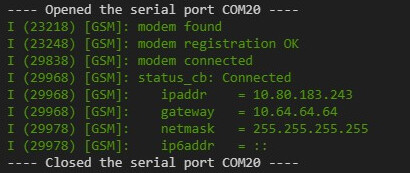
3.Regarding the device auth token, the code does it in the following function register_auth_key_cmd(), which in turn, it is invoked by app_main(). Also, the command was provided manually in the serial monitor as indicated in the instructions:
BLYNK> set_auth_token MY-DEVICE-AUTH-TOKEN with no successful result.
static void register_auth_key_cmd(void)
{
    esp_console_repl_t *repl = NULL;
    esp_console_repl_config_t repl_config = ESP_CONSOLE_REPL_CONFIG_DEFAULT();
    repl_config.prompt = "BLYNK>";
    repl_config.max_cmdline_length = 256;

    auth_cmd_args.token = arg_str0(NULL, NULL, "REDACTED", "blynk auth token");
    auth_cmd_args.end = arg_end(1);

    auth_cmd.command = "set_auth_token";
    auth_cmd.help = "blynk token configuration";
    auth_cmd.hint = NULL;
    auth_cmd.func = &blynk_cmd_cb;
    auth_cmd.argtable = &auth_cmd_args;
    esp_console_cmd_register(&auth_cmd);

    const esp_console_dev_uart_config_t hw_config = ESP_CONSOLE_DEV_UART_CONFIG_DEFAULT();
    esp_console_new_repl_uart(&hw_config, &repl_config, &repl);

    esp_console_start_repl(repl);
}
Please, let me know if more information is required from me.
Again, an apology for the incorrect initial posting.
Thanks a lot for your comments, and insight.